
The Lidl Sunscreen Principle
I brought a folding beach chair, some swimming goggles, an old cap and a bottle of Cien SPF 50 from Lidl to a sunrise shoot in Ibiza with Mica. None of these things were particularly glamorous. One of them was literally supermarket sunscreen.
And somehow, they gave me some of my favourite photographs of the morning.
-
El principio del protector solar de Lidl
Llevé una silla plegable de playa, unas gafas de natación, una gorra vieja y un bote de Cien SPF 50 de Lidl a una sesión al amanecer en Ibiza con Mica.
Ninguna de esas cosas era especialmente glamurosa. Una de ellas era, literalmente, protector solar de supermercado.
Y, de alguna forma, acabaron dándome algunas de mis fotos favoritas de toda la mañana.
A esas alturas ya habíamos hecho las fotos bonitas más obvias. Amanecer sobre el Mediterráneo, luz cálida, Mica con un bikini tan diminuto que llamar aquello “ropa de baño” ya parecía una descripción bastante generosa, y esa cantidad ridícula de energía que lleva dentro antes de que la mayoría de la gente haya tomado café.
Ya me había dado más poses de las que podía contar. Riéndose, girándose, mirando hacia otro lado, volviendo a mirarme, cambiando de posición antes de que yo hubiera terminado bien la foto anterior.
Así que, naturalmente, en vez de mantener las cosas sencillas, abrí mi bolsa de tonterías aleatorias de playa.
La idea era simple: darle algo que hacer.
Suena casi demasiado básico para ser útil, pero es algo a lo que vuelvo una y otra vez cuando fotografío a gente. En cuanto le dices a alguien que “pose”, puede pasar algo raro. De repente empieza a ser consciente de cada extremidad que tiene. Las manos se vuelven sospechosas. Los hombros se convierten en un problema. Hasta mirar hacia algún sitio empieza a parecer una decisión que necesita papeleo.
Pero dale a alguien una acción y la mitad de esos problemas desaparecen.
Le di a Mica el protector solar pensando que lo usaría como accesorio durante un par de fotos. Quizá sostenerlo, fingir que se ponía un poco en el brazo, dedicarme una mirada y seguir con otra cosa.
Mica no fingió.
Abrió el bote y empezó a cubrirse bien de protector solar. Brazos, hombros, piernas, extendiéndolo sobre la piel, girándose, sentándose, volviendo a levantarse. Luz dorada de primera hora, bikini diminuto, piel brillante y Mica consiguiendo que ponerse responsablemente SPF pareciera bastante más interesante de lo que probablemente Lidl había imaginado.
Y de repente las fotos cambiaron.
No tenía que decirle dónde poner las manos porque las tenía ocupadas.
No tenía que decirle dónde mirar porque estaba reaccionando a lo que hacía.
No le estaba pidiendo que “fuera sexy”, que suele ser una de las formas más rápidas de conseguir que algo se sienta forzado.
Simplemente lo era.
Ese terminó siendo el ritmo de toda esta parte de la sesión. La silla de rayas le daba un sitio donde sentarse, apoyarse y jugar con el cuerpo. Las gafas acabaron en sus manos, alrededor del cuello y durante un momento en algún lugar cerca de su cara. Mi gorra, un poco sucia, de alguna manera le quedaba unas cincuenta veces mejor a ella de lo que jamás me había quedado a mí, lo cual era irritante pero nada sorprendente.
Ninguno de esos objetos tenía nada de especial.
Ese es exactamente el punto.
Creo que a veces los fotógrafos nos convencemos de que un accesorio tiene que ser impresionante. Un coche vintage. Flores preciosas. Estilismo caro. Algo que grite concepto creativo antes incluso de que la modelo lo haya tocado.
Pero el objeto en sí casi da igual.
Lo que importa es si le da a la persona que tienes delante una razón para moverse.
Más tarde hice exactamente lo mismo sin utilizar ningún objeto. Le pedí a Mica que subiera hasta la parte de arriba de las pequeñas escaleras junto a las casetas de pescadores y que bajara despacio, mirando alrededor como si acabara de llegar allí.
Esa pequeña indicación cambió todo.
Ahora tenía un sitio al que ir. Algo a lo que reaccionar. Una razón para girarse hacia mí. Una razón para detenerse en un escalón. Una razón para tocar la pared, mirar hacia otro lado, sonreír y seguir moviéndose.
Y como estamos hablando de Mica, “despacio” seguía incluyendo unas doce microexpresiones y varias posiciones del cuerpo completamente distintas antes de llegar abajo.
Pero eso también forma parte de por qué me encanta fotografiarla.
Nunca se siente estática. Incluso cuando técnicamente está posando, siempre existe la sensación de que está a punto de pasar otra cosa.
Y eso es lo que realmente busco la mayoría de las veces.
No poses perfectas.
Pequeños trozos de vida.
Obviamente, ayuda cuando la persona delante de tu cámara se parece a Mica con un bikini diminuto bajo la luz cálida de Ibiza. No voy a fingir que esa parte sea irrelevante.
Pero el principio sigue funcionando.
La próxima vez que alguien se plante delante de tu cámara y de repente olvide qué suelen hacer los seres humanos con las manos, quizá no le des otra pose.
Dale algo que hacer.
Por lo visto, un bote de protector solar de Lidl sirve perfectamente.
Arnold ✌🏻
P.D. Si quieres ver el resto de aquella mañana con Mica, y cuando digo el resto quiero decir literalmente todo, está en Patreon. Las galerías completas, el BTS, los largos vídeos a cámara lenta, las historias detrás de las sesiones, esos pequeños momentos raros entre foto y foto y todo lo que nunca llega a Instagram ni al blog.
Y ni de lejos es la única sesión con Mica que hay allí. La he fotografiado una cantidad ridícula de veces a lo largo de los años, junto con muchas otras chicas muy guapas llevando bikinis que a veces parecían estar perdiendo una batalla contra el propio concepto de la tela.
Patreon es básicamente donde guardo el archivo completo de mi trabajo, no solo las fotos más pulidas. Sesiones antiguas, sesiones nuevas, galerías ampliadas, vídeos detrás de cámaras, historias, experimentos, errores, fotos favoritas, sesiones olvidadas y todos esos pequeños detalles que, de otra manera, acabarían desapareciendo en algún disco duro.
Si ya eres una de las personas que me apoyan allí: de verdad, gracias. Es gracias a vosotros que puedo seguir haciendo estas sesiones, escribiendo estas historias y convirtiendo todo esto en algo más grande que otra foto que desaparece en internet.
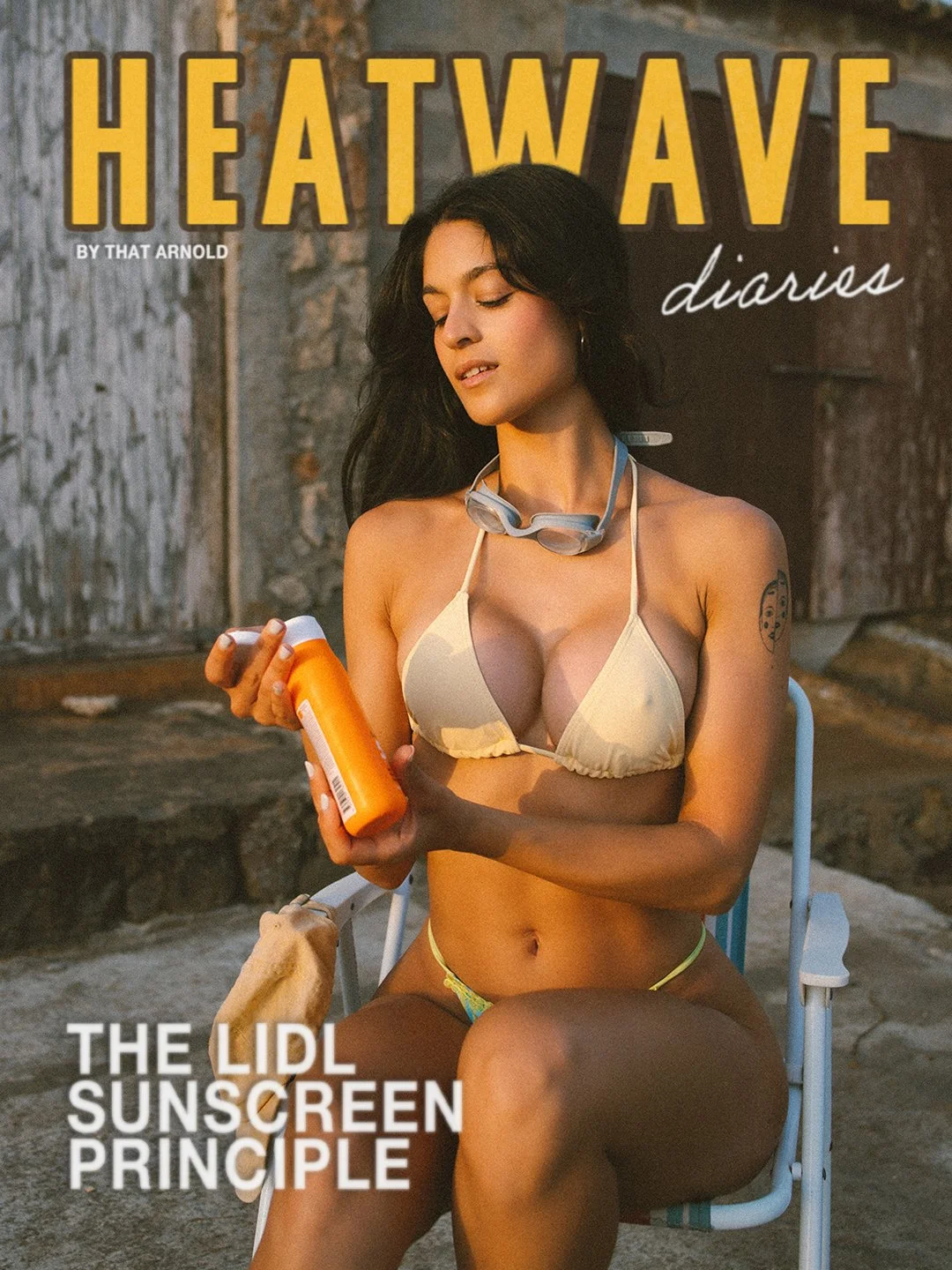
We had already shot the obvious beautiful stuff by then. Sunrise over the Mediterranean, warm light, Mica in a bikini tiny enough to make “swimwear” feel like a generous description, and that ridiculous amount of energy she seems to carry around before most people have had coffee.
She had already given me more poses than I could count. Laughing, turning, looking away, looking back, changing position before I had properly finished the previous frame.
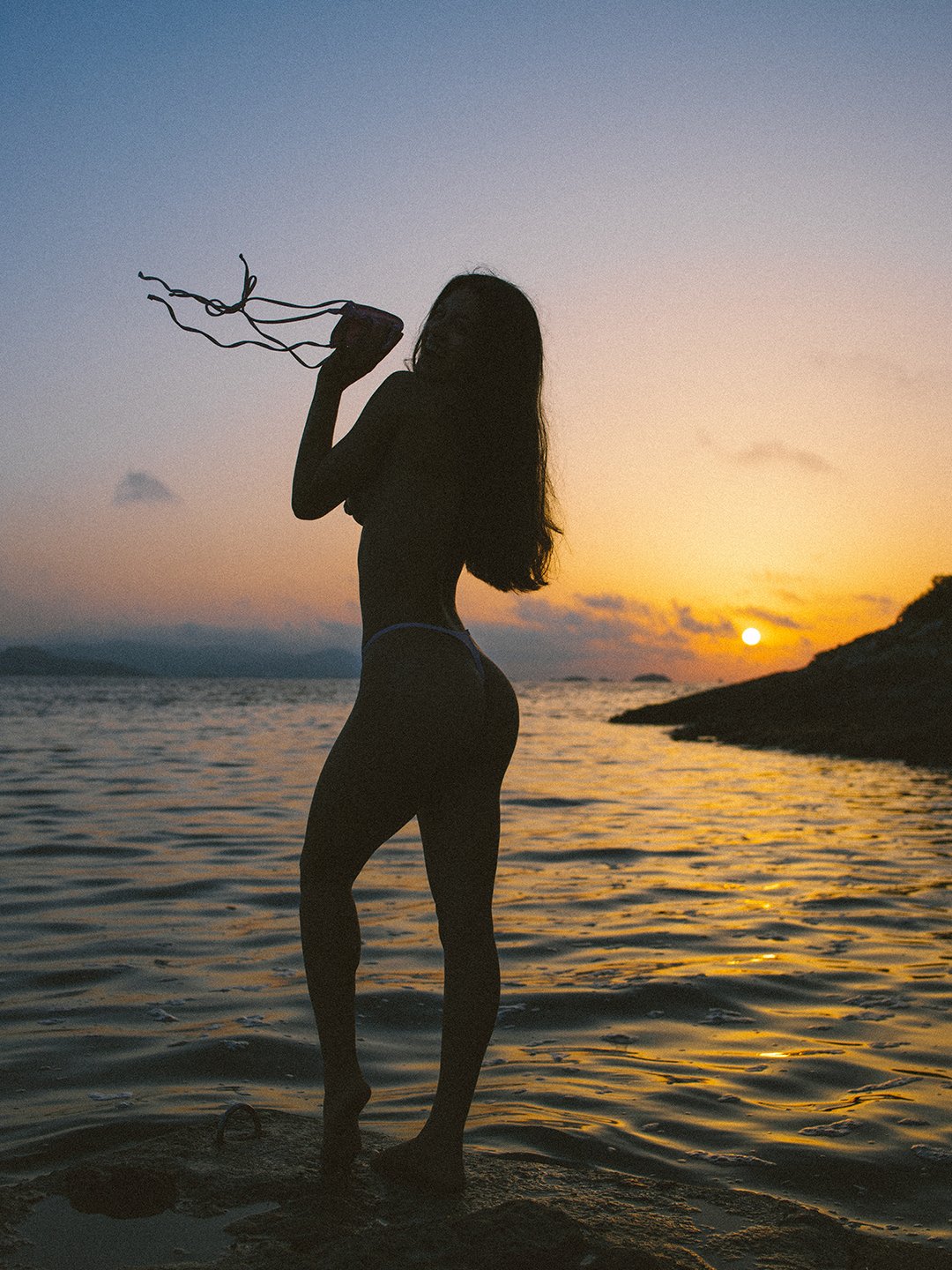
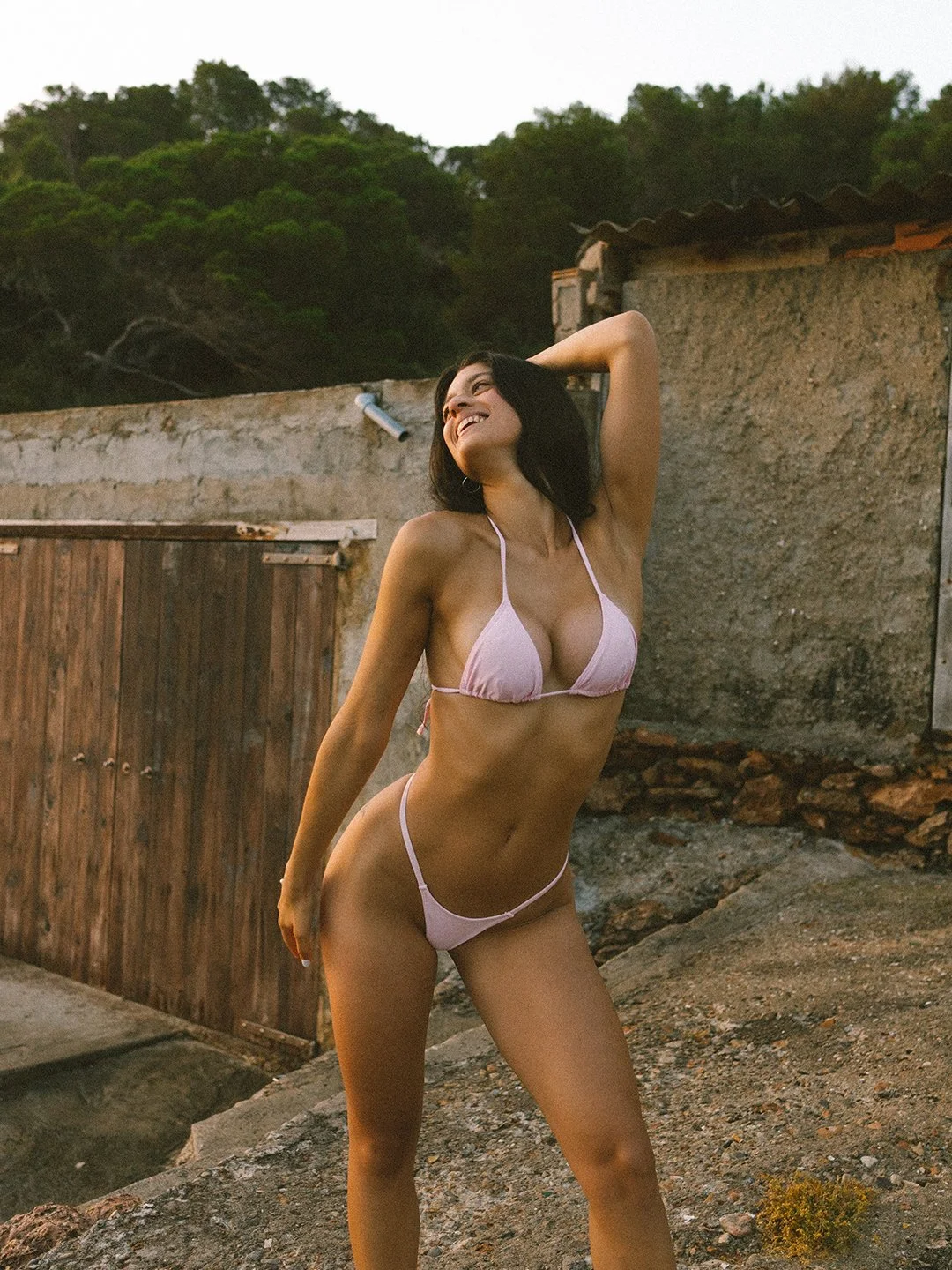
So naturally, instead of keeping things simple, I opened my bag of random beach nonsense.
The idea was simple: give her something to do.
That sounds almost too basic to be useful, but I keep coming back to it when I photograph people. The moment you tell someone to “pose,” something strange can happen. Suddenly they become aware of every limb they own. Hands become suspicious. Shoulders become a problem. Even looking somewhere starts feeling like a decision that requires paperwork.
But give someone an action and half of that disappears.
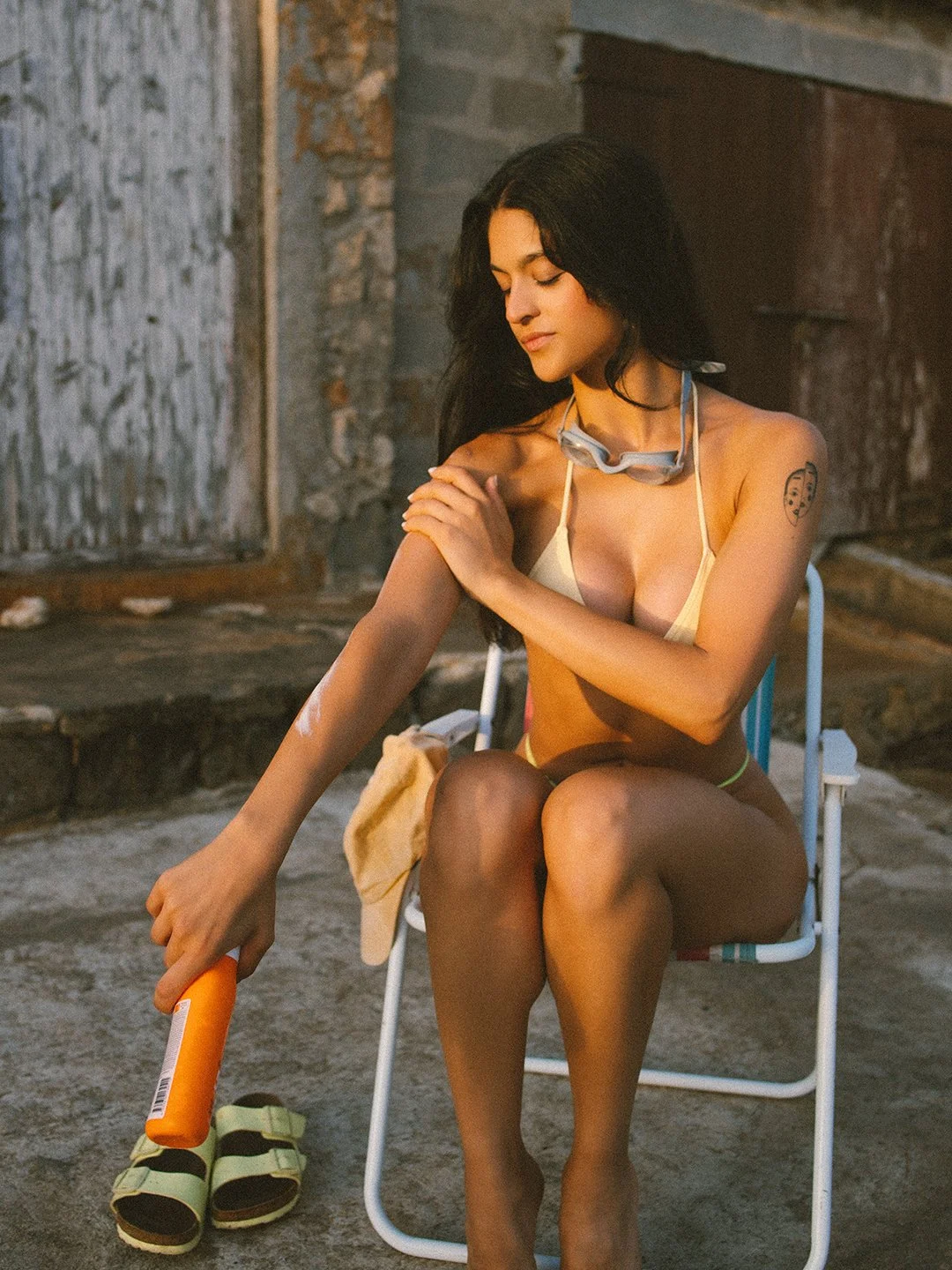
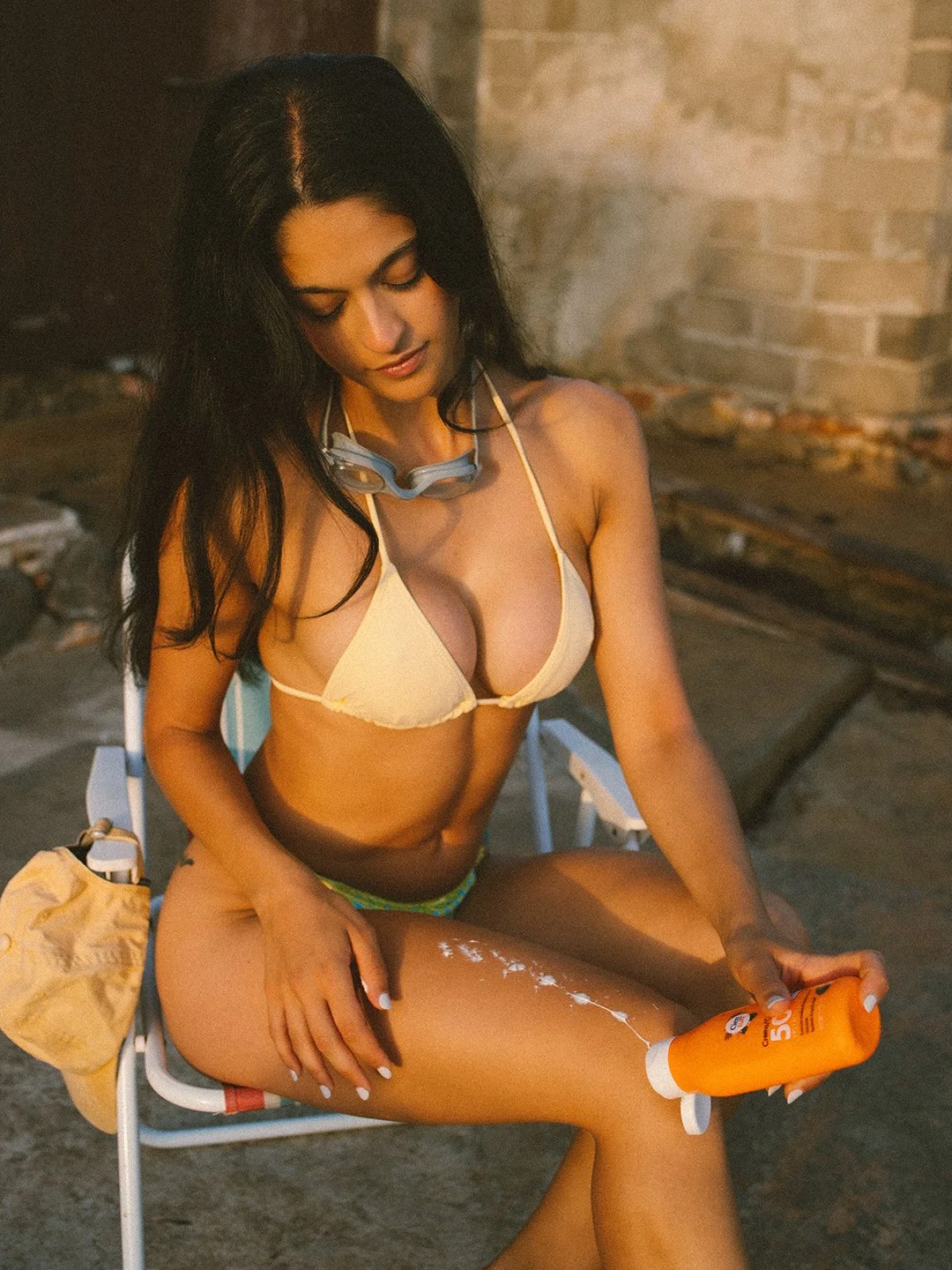
I handed Mica the sunscreen expecting her to use it as a prop for a couple of photos. Maybe hold it, pretend to put some on her arm, give me a look and move on.
Mica did not pretend.
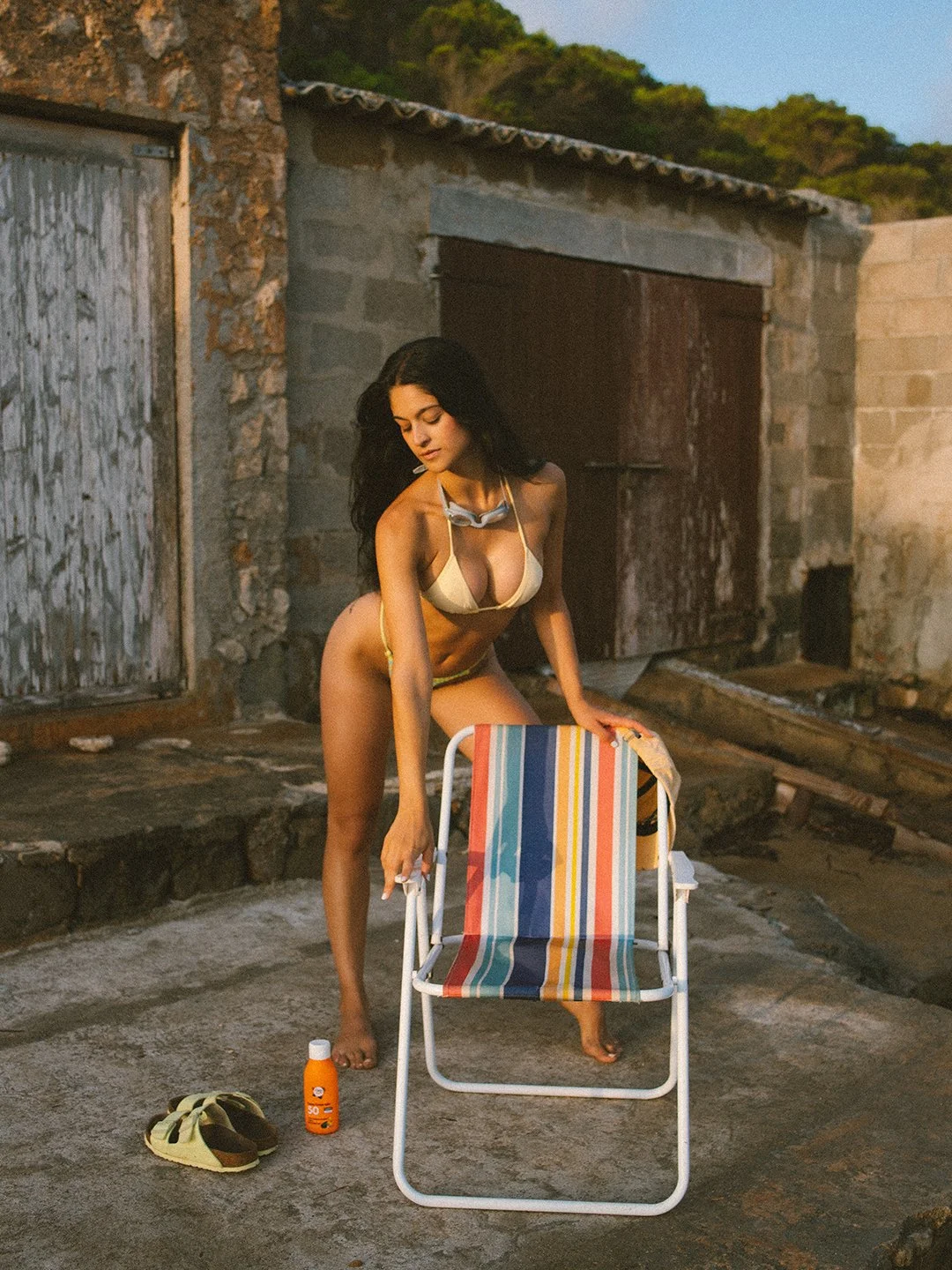
She opened the bottle and properly started covering herself in sunscreen. Arms, shoulders, legs, rubbing it into her skin, turning around, sitting down, standing up again. Golden morning light, tiny bikini, shiny skin and Mica somehow making responsible SPF application look considerably more interesting than Lidl probably intended.
And suddenly the photos changed.
I wasn’t telling her where to put her hands because her hands were busy.
I wasn’t telling her where to look because she was reacting to what she was doing.
I wasn’t asking her to “be sexy,” which is usually one of the quickest ways to make something feel forced.
She just was.
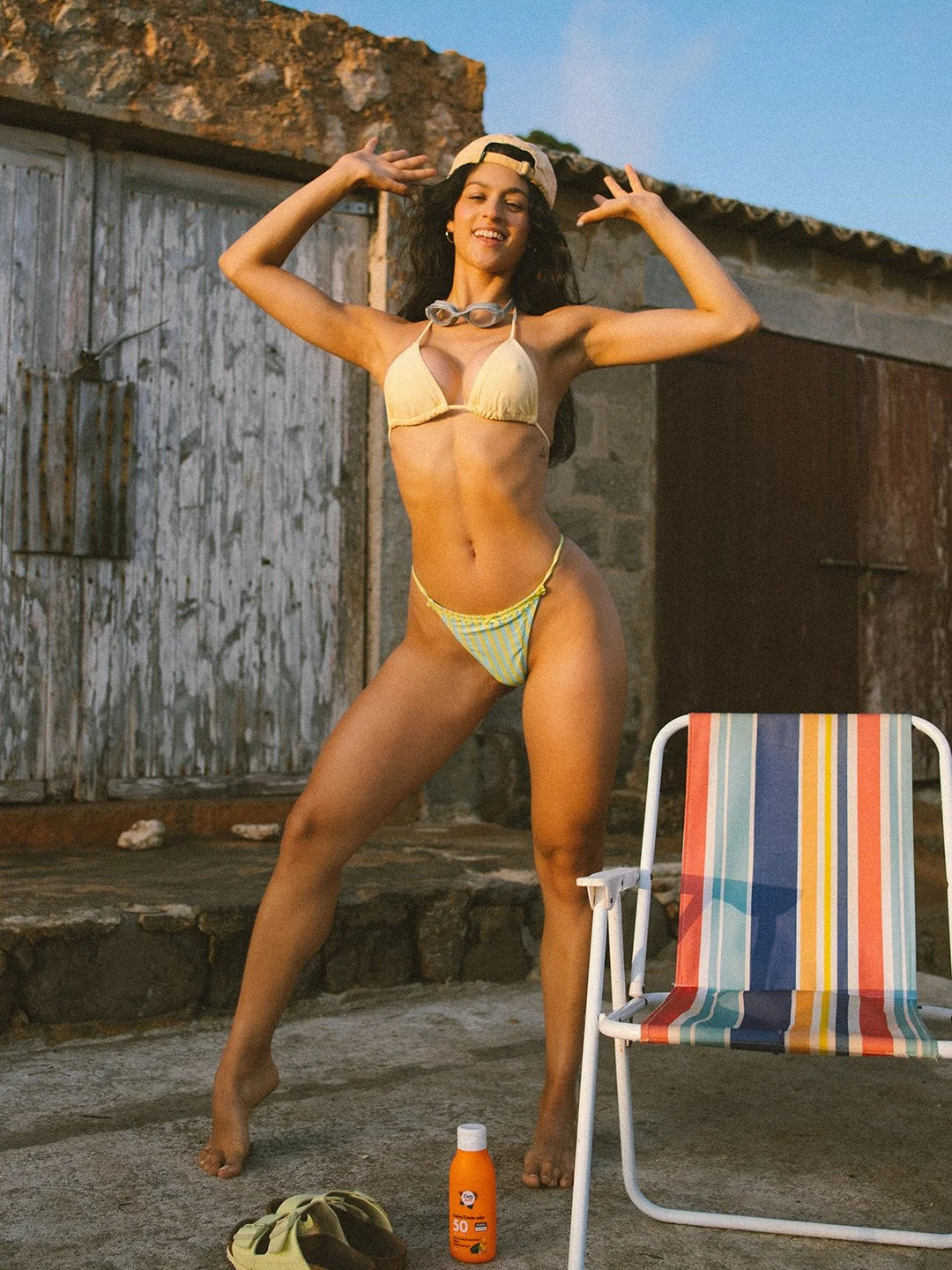
That became the rhythm of this whole part of the shoot. The striped chair gave her somewhere to sit, lean and curl herself around. The goggles ended up in her hands, around her neck and briefly somewhere near her face. My slightly dirty cap somehow looked about fifty times better on her than it ever had on me, which was annoying but not surprising.
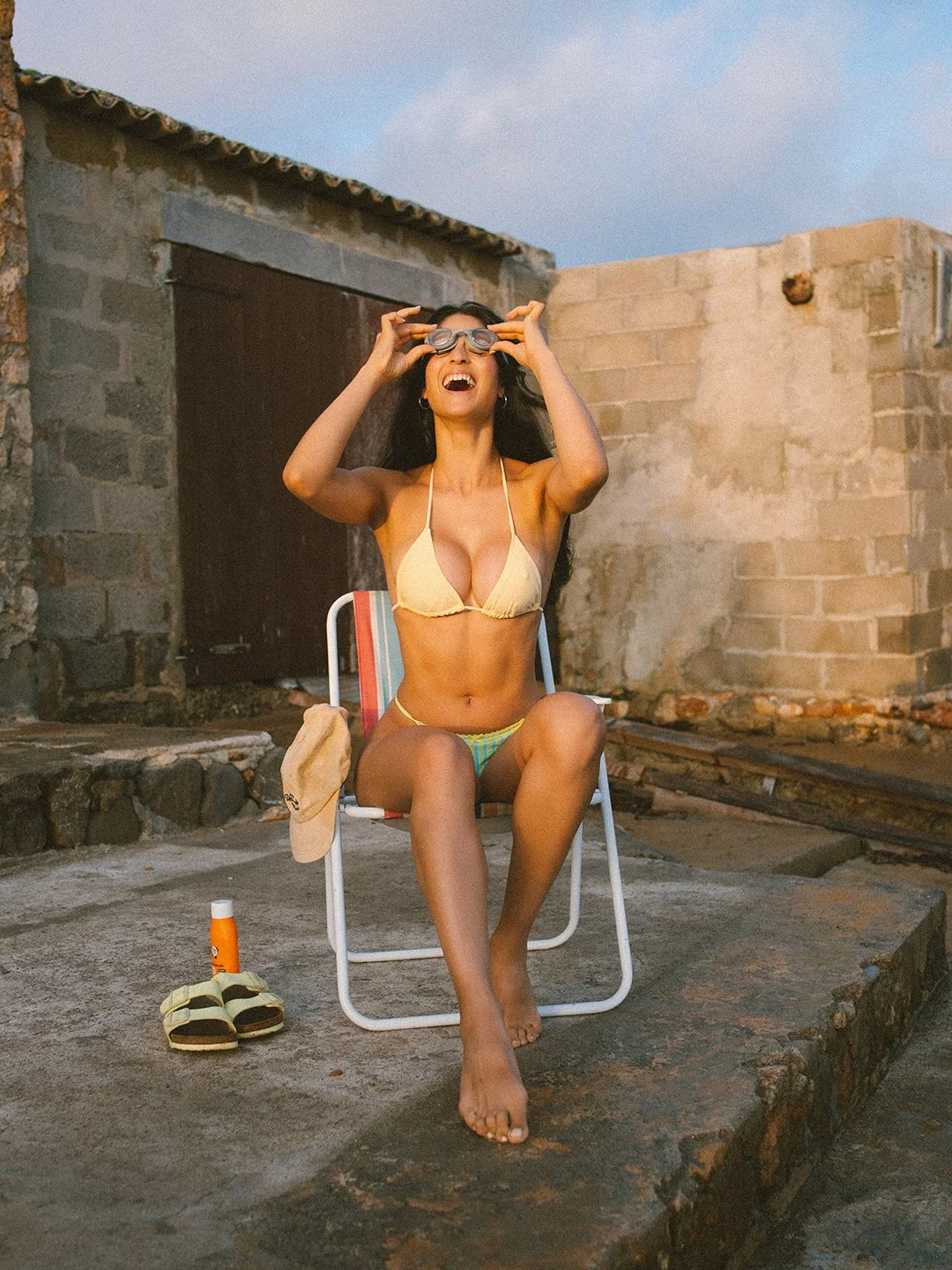
None of those objects were special.
That is exactly the point.
I think photographers sometimes convince themselves that a prop needs to be impressive. Vintage car. Beautiful flowers. Expensive styling. Something that screams creative concept before the model has even touched it.
But the object itself is almost irrelevant.
What matters is whether it gives the person in front of you a reason to move.
Later, I did exactly the same thing without using a physical prop at all. I asked Mica to go to the top of the little stairs beside the fishermen’s casetas and come down slowly, looking around as if she had just arrived there.
That tiny instruction changed everything.
Now she had somewhere to go. Something to react to. A reason to turn back towards me. A reason to pause on a step. A reason to touch the wall, look away, smile, keep moving.
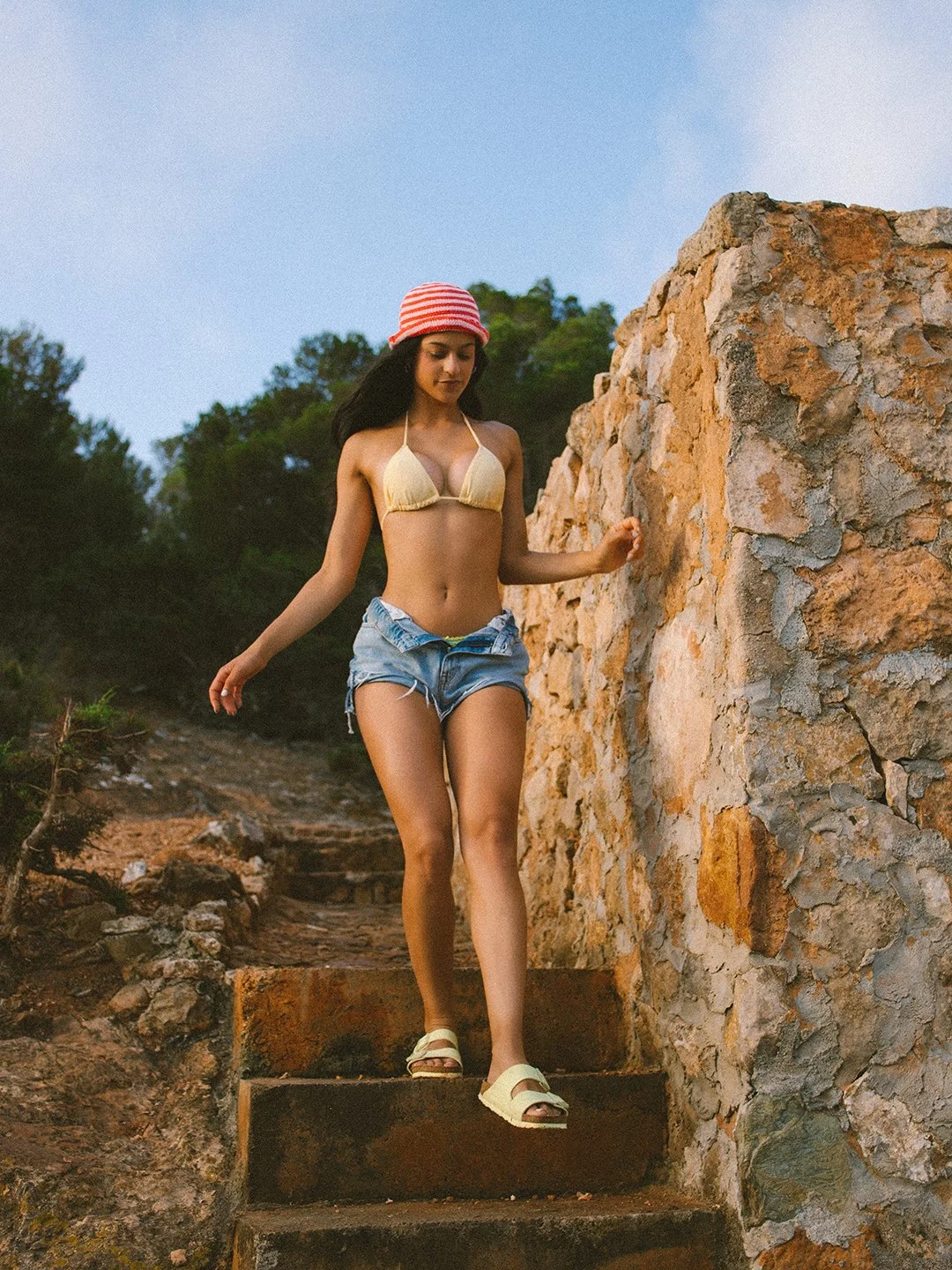
And because this was Mica, “slowly” still involved about twelve micro-expressions and several completely different body positions before she reached the bottom.
But that is part of why I love photographing her.
She never feels static. Even when she is technically posing, there is always the sense that something else is about to happen.
That is what I am actually looking for most of the time.
Not perfect poses.
Little pieces of life.
Obviously, it helps when the person in front of your camera looks like Mica in a tiny bikini under warm Ibiza light. I am not going to pretend that part is irrelevant.
But the principle still holds.
The next time someone stands in front of your camera and suddenly forgets what human beings normally do with their hands, maybe don’t give them another pose
Give them something to do.
Apparently a bottle of Lidl sunscreen will do.
Arnold ✌🏼
Oh, and by the way…
If you want the rest of this morning with Mica, I mean literally everything, it’s on Patreon. The full galleries, the BTS, the long slow-motion videos, the stories behind the shoots, the weird little moments between photos, and all the stuff that never makes it onto Instagram or the blog.
And this is very far from being the only Mica shoot in there. I’ve photographed her a ridiculous number of times over the years, along with a lot of other very cute women wearing bikinis that sometimes seemed to be fighting a losing battle against the concept of fabric altogether.
Patreon is basically where I keep the full archive of my work, not just the polished highlights. Old shoots, new shoots, extended galleries, behind-the-scenes footage, stories, experiments, mistakes, favourite frames, forgotten sets and all the little bits that would otherwise disappear somewhere on a hard drive.
If you’re one of the people supporting me there already: genuinely, thank you. It’s because of you that I can keep doing these shoots, writing these stories and turning all of this into something bigger than just another photo disappearing into the internet.